The landscape of British academia has undergone a seismic shift. As we navigate through 2026, the initial “panic” surrounding Generative AI (GenAI) has transitioned into a sophisticated, albeit complex, integration. According to the 2026 HEPI Student Generative AI Survey, a staggering 95% of UK students now report using AI in their daily learning workflows, up from 66% just two years ago.
However, this ubiquity brings a critical challenge: How do Russell Group institutions and regional universities maintain the prestigious “UK Standard” of academic integrity when the line between human effort and machine assistance is increasingly blurred?
The 2026 Landscape: Beyond Detection to “Process Visibility”
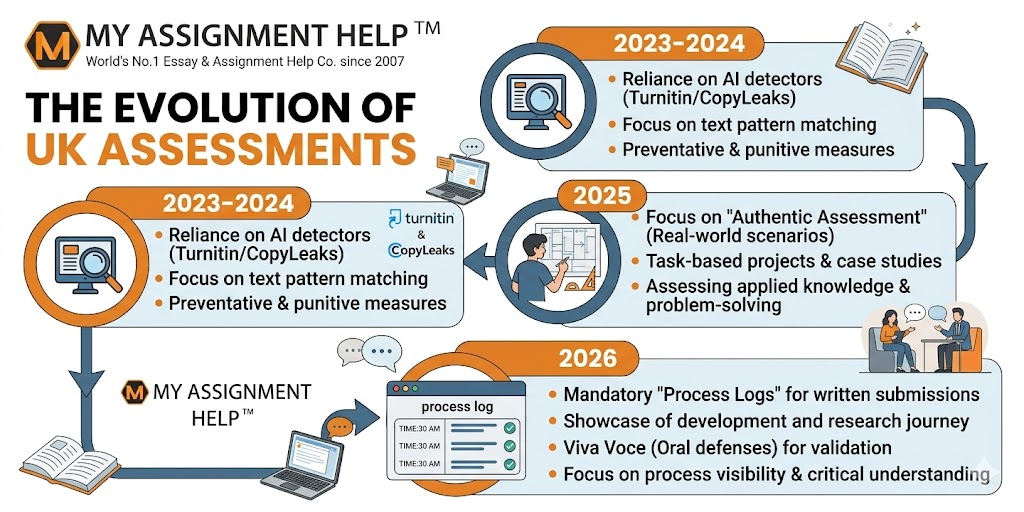
In early 2026, the Office for Students (OfS) and Advance HE signaled a move away from “detection-as-deterrent” models. Since AI can now act as a silent, invisible layer—assisting in everything from literature reviews to structural outlining—UK universities are shifting toward Process-Based Integrity Frameworks.
This means educators are no longer just looking at the final PDF submission. Instead, they are witnessing the writing process through version history, research logs, and “Fit to Sit” declarations. For students, the pressure to produce high-tier, original research remains high, leading many to seek structured support that adheres to these new transparency rules.
Navigating the Human-AI Hybrid Model
While 49% of UK students believe AI has improved their experience by saving time, there is a growing “anxiety gap.” Students are increasingly worried about false accusations of misconduct, with 65% noting that assessments have become significantly harder as a mitigation strategy against AI.
In this high-stakes environment, the need for human-led academic consultation is more vital than ever. Many students who struggle with tight deadlines often choose to do my assignments through professional platforms such as MyAssignmentHelp to ensure academic excellence. This choice often stems from the need for bespoke, data-driven research that AI tools—which still struggle with real-time UK-specific policy updates—cannot reliably provide.
The Skills Gap and the “Return on Credential”
As highlighted in the Deloitte 2026 Higher Education Trends report, there is a renewed focus on the “return on a credential.” Employers in the UK are looking for graduates who possess “AI literacy” but also exhibit “fundamentally human skills” such as critical judgment and ethical reasoning.
To stay competitive, students are diversifying their portfolios. With the rising demand for high-tier research, many subject matter experts now write papers for money to assist students in navigating complex dissertation requirements that require more than just a chatbot’s surface-level summary.
Key Takeaways for UK Students in 2026
- AI is Universal: 95% of your peers are using it; the key is how you use it ethically.
- Institutional Lag: Only 36% of students feel their university provides enough AI guidance.
- Assessment Evolution: Expect more “in-person” controlled assessments and “viva voce” (oral) defenses of your written work.
- Human Expertise Wins: AI cannot replicate the deep subject-specific nuance required for 1st-class honours in the UK.
See also: Augmented Reality in Smartphones
UK Academic Integrity FAQ
Q1: Can UK universities detect AI-generated content in 2026?
Most UK institutions use advanced “Authorship Analytics” that look for consistency in a student’s writing style over time, rather than just relying on simple AI probability scores.
Q2: Is using a writing service considered academic misconduct?
In the UK, using services for “model answers” or “tutoring” is a common study aid. However, submitting work that is not your own as a final assessment violates the Academic Integrity and Misconduct Policy (2025-2026). Students use these services for research guidance and structural templates.
Q3: What is the “Fit to Sit” policy?
Introduced widely in 2026, this policy requires students to declare they are mentally and physically fit before an exam or submission. Once submitted, you cannot usually claim “mitigating circumstances.”
Author Bio: Norman Rox
Norman Rox is a Senior Academic Consultant at MyAssignmentHelp with a Ph.D. in Accounting and over 12 years of experience in the UK higher education sector. He specializes in assisting postgraduate students with complex data analysis and technical writing.
References
- Higher Education Policy Institute (HEPI), “Student Generative AI Survey 2026,” Report 199.
- Advance HE, “Governance News Alert: Capabilities for a human-AI world,” February 2026.
- Deloitte Insights, “2026 Higher Education Trends: Focus on Value of Credentials.”
- Middlesex University, “Policy and Procedures for Academic Integrity and Misconduct 2025-2026.”