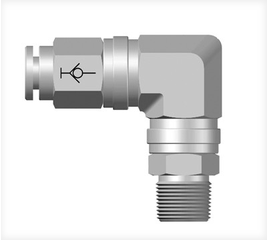
Walk through a dairy plant an hour after the shift ends, and you will smell the caustic before you see it. Hoses are out, foam is climbing the machine frames, and someone is aiming a hot spray at a cylinder mount that was never meant to take it. This is the moment pneumatic valve fittings either earn their place or start their slow failure. Brass looks fine on day one. Six months of alkaline foam and 60°C rinse water later, the story changes, and it usually changes at the worst possible time.
Washdown is not light duty. It is a chemical attack repeated two or three times a day, every day. Stainless pneumatic valve fittings hold up because the material was chosen for that fight, not adapted to it. The alloy forms a passive chromium oxide film that repairs itself when scratched or chemically stripped. That self-healing behavior is the reason 316 stainless steel dominates food-contact zones and sterile process areas.
What Washdown Chemistry Does to the Wrong Material
Cleaning cycles in food and pharmaceutical plants swing between extremes. Alkaline detergents lift fat and protein. Acid rinses strip mineral scale. Chlorinated sanitizers finish the job. Each step attacks a different part of a fitting.
Brass suffers first through dezincification. The zinc leaches out of the alloy, leaving behind a weak copper structure that looks intact and fails under pressure. Plated fittings fail differently. The plating gets nicked during install, moisture reaches the base metal, and corrosion spreads underneath the coating where nobody can see it.
Here is the part that catches maintenance teams out. A corroding fitting rarely bursts. It weeps. Air escapes slowly, the compressor runs longer, and pressure at the actuator drops just enough to slow a cycle without triggering an alarm. Production keeps running while the leak quietly bills you every hour of every shift. The U.S. Department of Energy estimates that compressed air leak losses account for 20 to 30 percent of total compressor output in a typical plant.
Stainless Steel Pneumatic Valve Fittings and Hygiene Requirements
Corrosion resistance is only half the argument. The other half is what happens to the surface.
Pitted metal holds product residue. Residue feeds bacteria. Bacteria form biofilms, and these survive cleaning cycles that would kill anything on a smooth surface. Once a niche establishes itself on a corroded fitting near a filling line, you are dealing with a contamination source that no amount of external spraying will clear.
Stainless keeps a smooth, non-porous surface through years of cleaning. The FDA’s Food Code lists corrosion resistance and smoothness among the material requirements for equipment surfaces in food environments. Auditors know this. When an inspector runs a gloved finger over a fitting cluster above an open product zone, dulled and pitted brass invites questions you would rather not answer.
Ask yourself what a failed audit actually costs. Not the fine. The recall, the retained lots, the customer who moves their contract.
Temperature and Pressure Behavior Under Real Conditions
Washdown water often runs hot. Steam cleaning runs hotter. Materials react.
Stainless check valve fittings hold their rating through those swings. A typical stainless pneumatic check valve handles up to 180°C and a pressure range of roughly 0.5 to 40 bar, so a hot rinse sits comfortably inside the working envelope. Polymer bodies do not behave that way. They soften, creep at the threads, and lose the seal geometry that made them tight in the first place.
Thermal cycling matters more than peak temperature. Heat, cool, heat again. Every cycle works the joint slightly. Materials with different expansion rates loosen against each other. Matching stainless fittings to stainless tubing keeps that movement predictable.
One plant engineer I spoke with described replacing the same elbow four times in a year before switching material. The fifth one is still in place.
The Cost Argument Nobody Makes Properly
Stainless costs more per piece. That comparison is the wrong one.
Compare the cost of a line stop during a production run. Compare the labor hours spent chasing a leak through a machine frame. Compare the value of one contaminated batch. A stainless fitting that outlives three brass replacements has already paid for itself, and it did so without consuming a maintenance window.
The strongest argument may be simpler. Fittings you never think about are the ones doing their job.
See also: The Ultimate Guide to Business Growth
Next Steps
Start with a survey rather than a purchase order. Walk your washdown zones and mark every fitting that sits within the spray path. Check for discoloration, green residue on the threads, or plating that has started to lift. Those are your first replacements.
Then check what sits directly above open product. Those fittings deserve stainless regardless of their current condition.
Sealexcel manufactures stainless steel pneumatic fittings and check valves in Mumbai, with in-house testing, including helium leak detection, in accordance with ISO 9001:2015-approved quality procedures. To discuss which configurations suit your washdown lines, contact the team at sales@sealexcel.com or call +91-22-4609 1815.